
OpenBread
The topic of “Bread”, one of the oldest foodstuff made by humans for humans, has many forms and formats, offering a wide range of texture and taste, aroma and appearance. Culturally loaded, bread offers a touch point into situated narratives, opening up to stories close to heart and hands-on. Today’s bread has a diverse range of manifestations, appropriations and expectations. Innovation and Design have been driving these for 14000+ years for flatbread and 4000 years for leavened … For long, it was contextually crafted. And then came a.o. the “modern sliced bread”. Did the slicing contribute to disconnect from the place and kill Food Literacy? What are the co-creation approaches we can explore in order to restore and/or expand Food Literacy? What are the roles of Smell, Sound, Touch, … in sensing and tasting Food, hence helping the experience and the literacy dimensions?
Bread is an entry point into Food Systems, and as an everyday vehicle for many, it allows to explore relations and interactions between stakeholders, while using it as a case for Food Literacy. Each coCreationcamp session is looking into some dimensions where Bread triggers questions and propositions related to food literacy, to behavior, to culture, to regeneration, and much more.
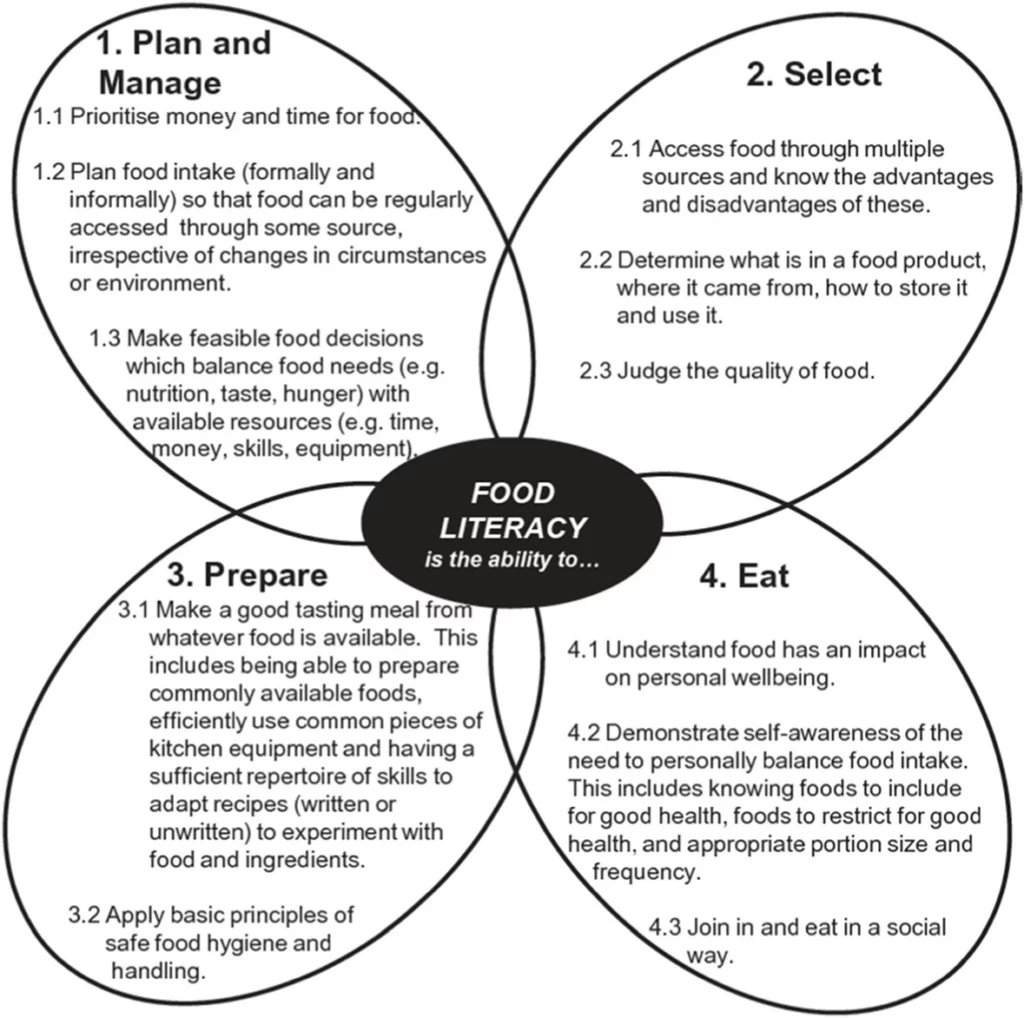
Vidgen & Gallegos [1] define food literacy as “… a collection of inter-related knowledge, skills and behaviours required to plan, manage, select, prepare and eat food to meet needs and determine intake” and the “… scaffolding that empowers individuals, households, communities or nations to protect diet quality through change and strengthen dietary resilience over time.” Their conceptualisation consists of 11 components organised under four inter-related domains of planning and managing, selecting, preparing and eating (see Fig.).
This definition is the first to be empirically derived, and is proposed by researchers as the most current, predominant approach to food literacy that is able to significantly advance the field. [2]
—
- Vidgen HA, Gallegos D. Defining food literacy and its components. Appetite. 2014;76:50–9.
- Thompson, C., Byrne, R., Adams, J. et al. Development, validation and item reduction of a food literacy questionnaire (IFLQ-19) with Australian adults. Int J Behav Nutr Phys Act 19, 113 (2022). https://doi.org/10.1186/s12966-022-01351-8
OpenBread is a series devised by Alok b. Nandi, amateur bread-maker and narrative architect-designer in multiple media.